
Genetics and Health
Explore how genes can affect your health, in big ways and small.
Your Starting Point
Let's get started with a few quick questions. This isn't a test — just a way to capture your starting point.
Welcome to Module 2!
Now that we've covered the basics in Module 1, we're ready to see how genetics actually shows up in our lives.
In this module, we'll explore the different ways our DNA influences our health. We'll look at everything from conditions caused by a single gene to more complex conditions shaped by a mix of many genes, lifestyle, and the environment. Together, these concepts explain how health risks are passed down through families, and how genetic insights can help us make more informed health decisions.

Introduction
Our DNA makes us unique
As we learned in module 1, your body is built and run using genetic instructions called DNA. These instructions help shape how your body grows and functions and how it responds to the world around you.
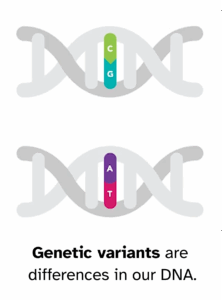
Each of us has a unique set of DNA, and the DNA differences between us can influence our traits and our health.
Two common genetic patterns
There are two main ways that genetics can influence health.
- In some cases, a single genetic variant (difference) can have a big impact on health.
- In other cases, many common genetic variants, along with lifestyle and environment, combine to influence our health.
Both patterns are important to understand, and we'll dive into each one.
Monogenic Conditions
Monogenic conditions (also called single-gene conditions) are caused by individual genetic variants with a big impact. They're called "monogenic" because "mono" = one, and "genic" = gene. While each monogenic condition is rare on its own, together they affect many people.

How can a single genetic variant — out of the 3 billion DNA letters in the human genome — have such a big impact?
Remember that genes contain instructions for making proteins, which do most of the work in our bodies. When a genetic variant changes these instructions in a big way — for example, by deleting part of the gene or changing an important DNA letter — the resulting protein may not work correctly. This can sometimes lead to health problems.
Here are some examples of monogenic conditions and how they're inherited. Continue below to learn more about these different inheritance patterns.
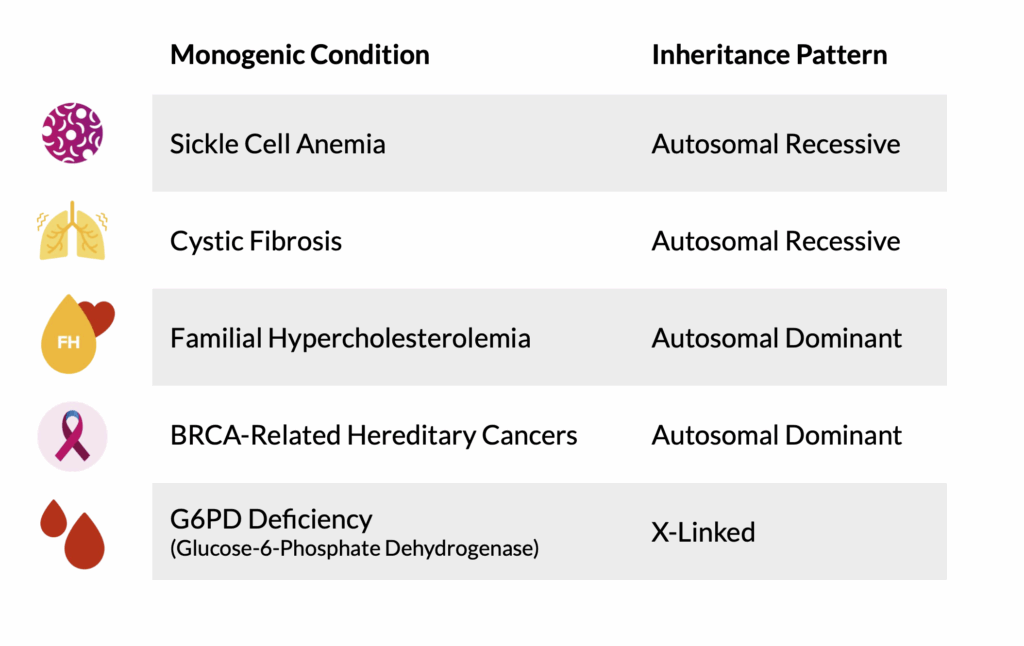
One important note: Even for conditions caused by changes in a single gene (monogenic conditions), lifestyle and environment can still play a role, influencing whether symptoms appear, when they start, or how severe they become.
One unique aspect of monogenic conditions is that they tend to follow predictable inheritance patterns. For example, some conditions appear in every generation, while others may seem to "skip" a generation or appear unexpectedly.
Download this summary of common inheritance patterns and save it as a quick reference.
Real World Example
From DNA to Symptoms: Sickle Cell Anemia
Sickle cell anemia is a blood disease that affects people worldwide. It is most common in people with African ancestry but also occurs in people with Middle Eastern, South Asian, Mediterranean, Central and South American, and Caribbean ancestry. In the U.S., about 1 in 13 Black and African Americans is a carrier.
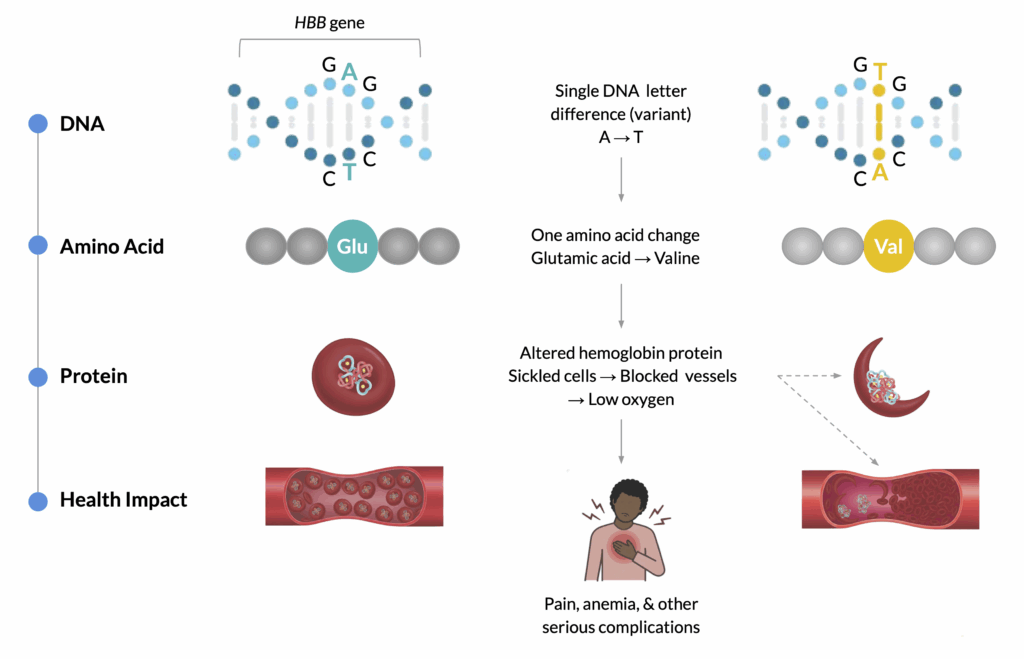
Sickle cell anemia is a monogenic condition inherited in an autosomal recessive pattern. It is caused by a single genetic variant in the HBB gene, which provides instructions for making hemoglobin — the protein in red blood cells that carries oxygen throughout the body.
As shown in the diagram below, a one-letter change in the DNA sequence of the HBB gene leads to a single amino acid change in the hemoglobin protein. This small difference alters how hemoglobin works, affecting how red blood cells function.
In people who inherit two copies of this variant, the altered hemoglobin causes red blood cells to become rigid and sickle-shaped. This reduces oxygen transport and can block small blood vessels, leading to anemia, episodes of pain, and other serious complications.
Advances in genetic research have led to promising new treatments, including gene therapies, that target the underlying genetic cause of sickle cell anemia. While these treatments offer new hope, scientists and doctors are working to make them available to everyone who might benefit.
Was this learning activity useful?
Complex Conditions
As we learned earlier, monogenic conditions are caused by single genetic variants with a big impact.
Complex conditions are different. What makes them complex is that many genetic variants, along with non-genetic factors, interact to influence risk.
Here are some examples of complex conditions. You may recognize many of them because they're common and affect the health of millions of people.
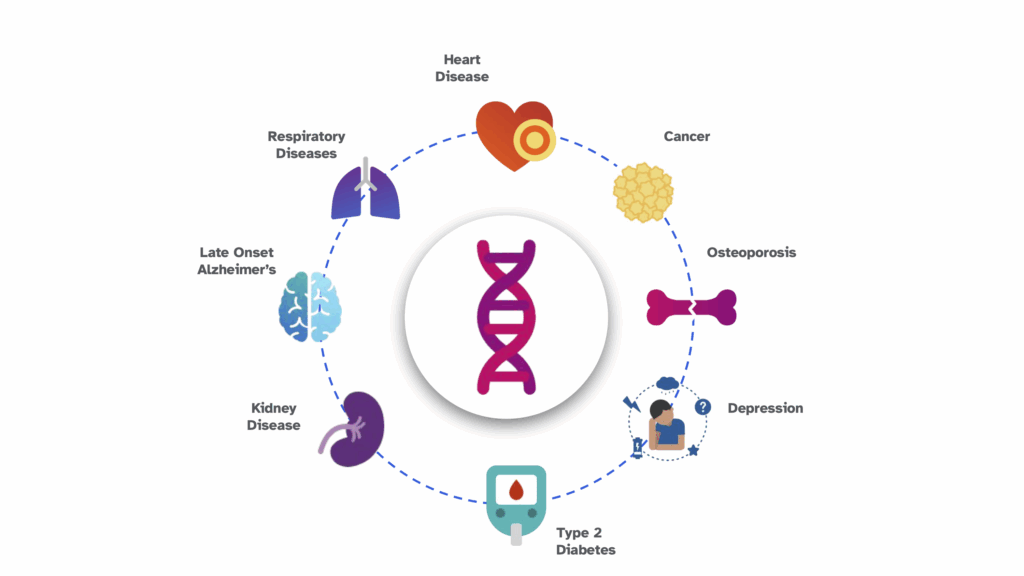
Let's dive into how genetics and non-genetic factors impact risk for complex conditions.
Because many genes are involved, the genetic component of complex inheritance is called polygenic risk (poly = many; genic = genes).
In this illustration, the blue and pink dots scattered across the chromosomes represent different genetic variants. Some variants increase risk (pink) and others decrease it (blue). And some variants carry more weight in the overall risk than others (represented by different sizes of dots).

Individually, each of these genetic variants has a small effect, but combined they can have a meaningful impact on risk.
In addition to genetics, the chances of developing a complex condition are often impacted by many non-genetic factors. Examples of these types of factors include:
- Lifestyle: Personal habits such as diet, physical activity, sleep, and smoking
- Environment: External exposures such as sunlight, pollution, or infections
- Other factors: Things like age and sex

While complex conditions tend to cluster in families, they don't follow the same predictable inheritance patterns as monogenic conditions. This is because we each inherit a unique mix of many common genetic variants from our parents, and because other factors like lifestyle and environment play an important role, too.
Was this learning activity useful?
A Quick Comparison
Download this simple comparison of monogenic and complex conditions to help you understand different genetic patterns, and keep it as a quick reference for later.
Was this learning activity useful?
What's the Cause?
Hi everyone, I'm Stacey, a genetic counselor - a healthcare professional trained to help individuals understand how their DNA, and their family history impact their health.
If I asked you what causes heart disease, you'd probably point to lifestyle, including diet and exercise. And you’d be right—mostly. But, as we’ve been exploring, lifestyle is only part of the story. Our genes also play a role, and that role looks different for everyone.
Today we'll look at two individuals to see how genetics can influence the heart in very different ways. Whether it’s one gene making a big impact or a thousand small genetic variants working together, knowing your genetic "why" can change the way you and your healthcare provider care for your heart.
First, let's look at David. At 32, David is the picture of health—he's a runner, eats well, and feels great. But during a routine checkup, a blood test revealed a shock: his "bad" LDL cholesterol was dangerously high.
It didn't make sense to David or his doctor until they looked closer at his family tree and noticed a pattern: Many of his family members had been diagnosed with high cholesterol or heart disease at an early age, some as early as their 40s.
David's doctor was concerned there might be an underlying genetic cause for his very high cholesterol and talked about the option of genetic testing. David decided to pursue testing which found a variant in a single gene: the LDLR gene. This led to a diagnosis of familial hypercholesterolemia (FH for short), a monogenic condition that causes very high levels of cholesterol which can lead to heart disease at a young age.
In a monogenic condition like FH, one gene has a big impact. Even though lifestyle is still important, no matter how many miles David runs, it likely won't be enough.
So, how did knowing the genetic "why" impact David? Well, David’s doctor started him on a cholesterol lowering medication and genetic testing was coordinated for his at-risk family members, including his young daughters, who were found to have inherited his genetic variant. They can now prioritize heart-healthy habits and monitoring, decades before a problem starts. In David's case, this genetic knowledge helped protect more than just his own heart.
Now, let's turn to Arti. Like David, Arti has high cholesterol and a family history of heart disease in her family, though it usually shows up later in life—in their 60s or 70s.
Arti decided to pursue genetic testing to better understand her health. Unlike David, her results didn't uncover a single genetic variant. Instead, she found she had a slightly higher polygenic risk. This means she inherited many different DNA variants that, when added up, make her more likely to develop heart disease than others. And her high cholesterol is the result of a complex combination of many genetic and non-genetic factors including lifestyle.
While David needed immediate medical intervention, Arti's "why" gave her a different tool: motivation. Knowing she has this underlying genetic "push" toward heart disease showed her the importance of a healthy lifestyle. She used that knowledge to stay proactive with her diet and exercise and focus on heart health with her doctor.
As we saw, David and Arti both have high cholesterol and a family history of heart disease, but they learned through genetic testing that their "whys" were very different.
For David, his genetic discovery was a call to immediate medical action that impacted the whole family. For Arti, it was the motivation she needed to commit to a heart-healthy lifestyle.
For both of them, knowing the "why" led to a better plan and a healthier heart.
Sometimes, the same health condition — such as heart disease — can be caused by a single gene or have a more complex cause, depending on the family.
Distinguishing between these two causes is really important, because it can help determine risk to family members and guide decisions on how to prevent or manage the condition.
Watch the video above about heart disease to learn more.
Was this learning activity useful?
Congratulations!
Congrats on finishing module 2! We've now explored the different ways genetics connects to our health. We looked at everything from monogenic conditions that are caused by changes in a single gene, to more complex conditions shaped by many different genetic, environmental, and lifestyle factors. We also learned how the same health condition can have different causes in different people.

Next up, let's see how these genetic patterns show up across generations as we dive into family health history.
What You've Learned
You're almost done! These questions help you check in on what you learned and help us improve future learning experiences.
Share Your Feedback
We’d love your feedback. This brief, anonymous survey asks about your experience with the module and how well it supported your learning. Your responses help us improve future modules.