
Family Health History
Learn how to collect your family's health history and identify clues to health risks.
Your Starting Point
Let's get started with a few quick questions. This isn't a test — just a way to capture your starting point.
Welcome
Welcome to Module 3! Now that we've explored how genes shape our health, it's time to see how genetic variants show up across generations by diving into family health history.
In this module, we'll explain how to collect your family health history, including who to talk to, what details to collect, and certain "red flags" to watch out for. We'll also explore how family history and genetic testing can work together to give you a more complete picture of your health.
Let's get started!

Introduction
Why collecting family health history matters
We share DNA with our family members, and DNA plays an important role in our health. Family members often have other things in common, too, like where they live, what they eat, or how active they are. These shared factors can all influence the chances of developing certain health conditions, which is why these conditions often run in families.
By tracking which medical conditions appear in your family, you and your doctor can better understand your health risks and personalize your care.
How-to guide
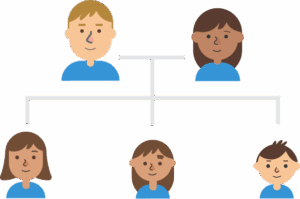
Your family health history is a record of current and past medical conditions for you and your family. Collecting a family health history does not need to be complete or perfect; whatever information you have can be useful when it's shared with your doctor.

Family health history focuses on biological relatives, because the goal is to understand health conditions and risks that are due to shared DNA.
Try to gather information on the following family members when possible:
- Yourself
- Parents
- Grandparents
- Children
- Grandchildren
- Siblings (including half-siblings)
- Nieces and nephews ("niblings")
- Aunts and uncles
You share at least ~25% of your DNA with each of these family members, which is why they're most important to talk with.
What's a pedigree?
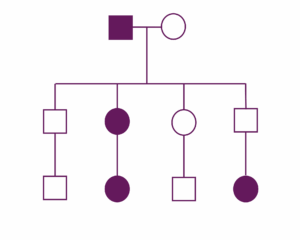
A pedigree is a family tree that uses simple symbols and lines to show biological relationships and how traits or health conditions may be inherited. Individuals with the condition of interest are represented by filled-in shapes, while those without the condition are shown as empty shapes.
A note on non-biological family: Members of your household who are not biological relatives (like a step-parent or an adoptive sibling) are also important to your health story because of the environment and lifestyle you share. However, family health histories focus on biological relatives, because we're looking for specific risks related to shared DNA.
For each family member, there are two types of information that are most important to gather:
- Major health conditions: The most important conditions to ask about are ones that are chronic (long-term) and/or serious. It can help to start with a prepared list of conditions, which can guide conversations with family members and make the information easier to share. The table below outlines key categories of conditions to ask about.
- Approximate age of diagnoses: Try to find out how old your family member was when the health condition started. Some conditions, like heart disease and certain cancers, are more likely to have a strong genetic component if they occur at an earlier age than usual. It's ok if you or your family member don't know the exact age; "in their 40s" or "before age 50" is still very helpful.
Common categories of health conditions to ask about include:
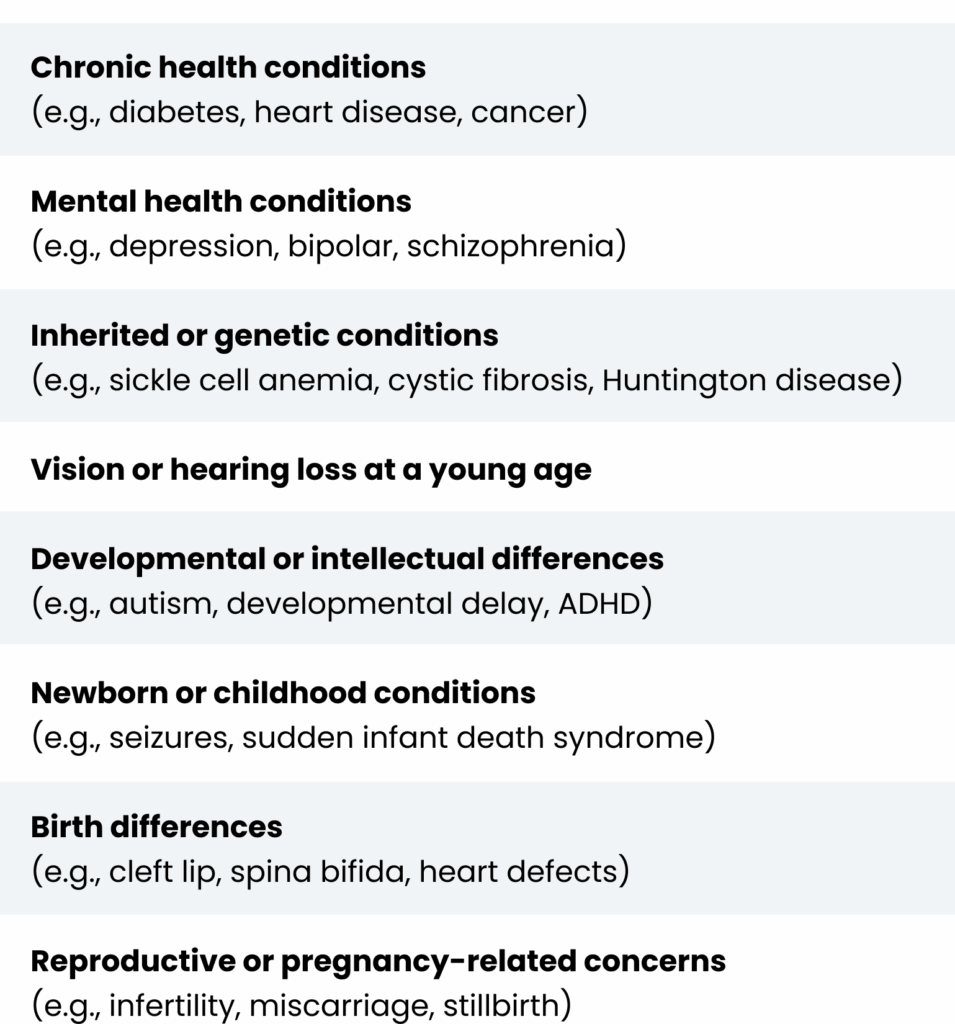
See the downloadable Family Health History Worksheet in a later activity for more examples of conditions.
And remember to keep your family history up-to-date! As time goes on, people may remember old health issues or develop new ones. You may even have new family members to add. Family gatherings like Thanksgiving can be a great time to collect this information.
Once it's recorded, share your family health history with a healthcare professional. They are trained to interpret this information, assess your potential risks, and help you understand what it means for your personal care.
And if your family members are comfortable, share your findings with them, too. Up next are some tips on talking to relatives.

Was this learning activity useful?
Family conversations
Tips for talking with relatives
Talking about family health history can feel uncomfortable for some people. Here are a few approaches that may help:
- Start with family members you know well. These initial conversations can help you get comfortable asking health questions before you reach out to others.
- Explain why you're asking. For example, you can mention that collecting this information can help keep your family healthy, and that it will be helpful for future generations.
- Use family gatherings as an introduction. Holidays, reunions, and family dinners can be a great time to start a conversation. You can then follow up with certain family members for private and more detailed conversations.
- Talk with older relatives. They may remember health information about earlier generations.
- Respect your family members' privacy. If someone seems uncomfortable or doesn't want to share, let them know you understand and that you're available to talk later if they change their mind. You can also offer to share your own health information first, or ask if they'd feel better sharing written notes rather than having an in-person conversation.
- Write information down as you go. Recording details in writing helps avoid confusion and allows you to update the history over time.

Recognizing red flags
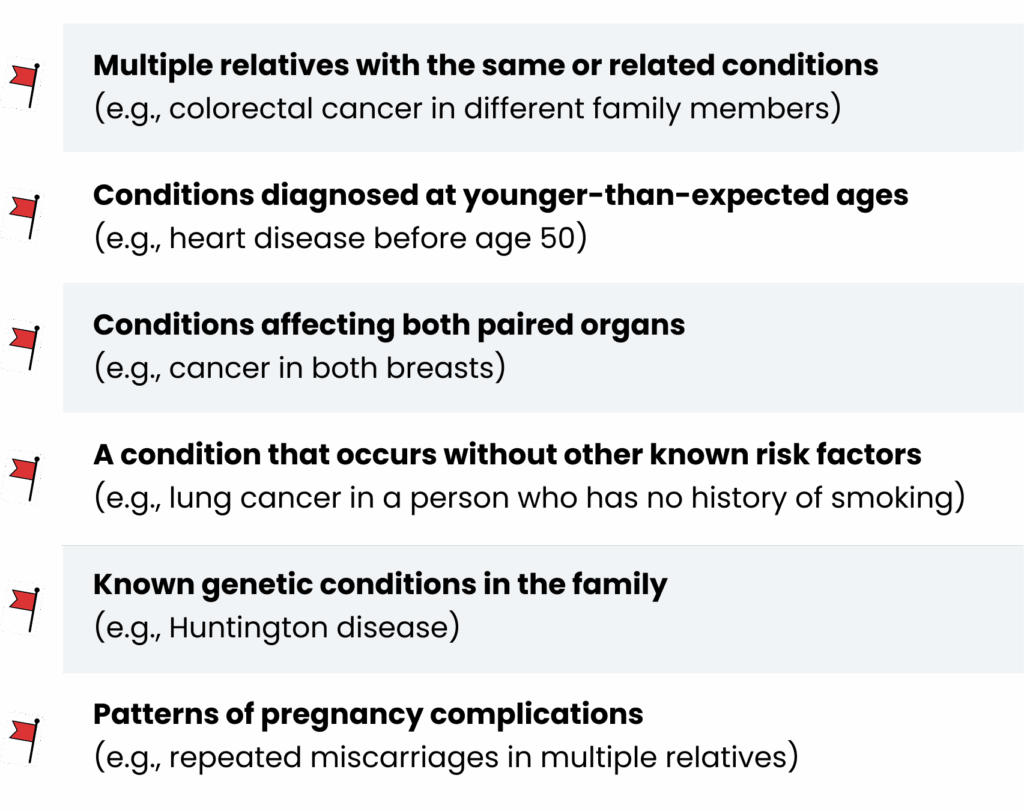
While nearly every family has some history of health issues, certain patterns — called "red flags" — can suggest that a condition may have a stronger genetic or familial component.
Identifying these patterns is not a diagnosis, but it's a signal that a more in-depth conversation with a healthcare professional is a good idea. That conversation might lead to recommendations for earlier or more frequent screenings, lifestyle changes, or even genetic testing to get a clearer picture of your risk.
See the table below for examples of these red flags.
Was this learning activity useful?
Practical tools
Tools for collecting and organizing family health history
Collecting and organizing your family health history can feel like a big task, but there are tools available that can help:
- The U.S. Surgeon General's My Family Health Portrait is a free online resource that will help you build a pedigree and a table detailing your family health history.
- Many healthcare systems also offer tools connected to electronic health records (EHRs), and most healthcare professionals have family history forms for patients to complete.
- If you're a 23andMe health member, you can access the Family Health History Tool to record your information.

Another way to gather and organize your family health history is to work with a genetic counselor. Genetic counselors are healthcare professionals who specialize in understanding how health conditions are passed down through families. Through a guided question-and-answer process, a genetic counselor can collect your family health history and build a structured pedigree to identify patterns and red flags. They can also help you determine if genetic testing might be appropriate based on your personal and family health history.
If you're interested in talking with a genetic counselor, you can find one through the National Society of Genetic Counselors website. And if you'd like to learn what it's like to talk to a genetic counselor, you can watch a mock session on the DNA Today podcast.
Worksheet
In addition to the tools above, we've also created this downloadable family health history worksheet to help you collect and organize your information.
Was this learning activity useful?
What if you don't know?
What if you don't know your family health history?
Not everyone has access to a complete family health history. If you're adopted, donor-conceived, or have limited contact with biological relatives, gathering this information may be more challenging.
If your history is incomplete, that's ok. Focus on the information you do have. Your own personal health records or genetic testing may provide helpful insights. For some people, seeking out biological relatives feels like an important step in understanding their health history, while for others, it may not be the right choice. There's no single "correct" approach. It's about what feels right for you.
Family health history is one tool for understanding risk, but it's not the only one. Even with limited information, you can still take proactive steps for your health.

Video
Hi, I'm Anne, a genetic counselor at the 23andMe Research Institute. Genetic counselors help individuals and families understand how genetic information — including genetic test results and family health history — can affect their health and the health of their relatives.
Family history gives us a big-picture view. It shows patterns of traits and health conditions across generations and helps us see how conditions may be inherited or influenced by shared environments.
Genetic testing looks more directly at DNA - our body's instructions inside our cells. It checks for specific genetic changes, or variants, that may increase the chance of developing certain health problems, such as monogenic conditions.
You can think of family history and genetic testing as two pieces of the same puzzle. Sometimes they tell the same story. Other times, they don't. Let's look at two examples.
Meet Sarah. She's 45, healthy, and is proactive about her health. Several women in her family have had breast cancer, so she decides to have genetic testing that includes the BRCA1 and BRCA2 genes.
Her results showed that no cancer-related variants were detected in those genes. Sarah feels relieved — but also confused. If no variants were found, why have so many of her relatives had cancer? When she and her doctor review her family history, they see a clear pattern: multiple relatives with breast cancer, some diagnosed at younger ages.
In Sarah's case, there is a positive family history, but no genetic variants found.
Why might this happen?
- She may still have a genetic variant, but the test she took didn't detect it.
- There may still be a genetic variant in the family, but Sarah did not inherit it.
- Or, the cancers could be related to shared genetic, environmental, and lifestyle factors rather than a single monogenic cause.
- So what does this mean for Sarah?
Even without a genetic finding in her test, Sarah and her doctor still need to consider earlier and more frequent screening based on her family history. In this case, Sarah's family history adds important information that the current genetic test didn't identify.
Let's look at another example: Meet Danielle. She's 34, healthy, and is also proactive about her health – but her experience is different. She learns through a direct-to-consumer genetic test that she has a BRCA1 genetic variant.
She's surprised — she didn't think cancer ran in her family. The only cancer she knows of is an uncle with prostate cancer.
This is the opposite situation to our first case: here, there's no obvious family history, but a positive genetic test result.
Why might this happen?
- The family may be small, making patterns harder to recognize.
- Some relatives may still be young and haven't developed symptoms yet.
- And certain cancers, such as prostate cancer, may not be recognized as related to BRCA variants.
In this case, genetic testing reveals a risk that family history alone did not show.
Importantly, Danielle does not have cancer. But this result means she has an increased risk and will need to discuss screening and prevention options with her healthcare provider.
Let's put this all together.
Family history and genetic testing provide different — but complementary — genetic information. Family history helps us recognize patterns across generations. Genetic testing identifies specific inherited variants that may increase risk. One does not replace the other. Together, they help us better understand risk and make more personalized healthcare decisions. That's why collecting – and updating – your family health history is such an important step in understanding health risks for you and your family.
Watch the video above to learn how family health history and genetic testing work together.
Was this learning activity useful?
Congratulations!
Congrats on finishing Module 3! In this module, we shared some practical tips on how to collect and organize your family health history, including who to talk to and what questions to ask. You learned how to spot important clues (called "red flags") that may warrant deeper conversation with a healthcare professional. And we explored how family history and genetic testing can provide important and complementary information about your health.
Now you're ready to put those skills to work as you start collecting your own family health history!

What You've Learned
You're almost done! These questions help you check in on what you learned and help us improve future learning experiences.
Share Your Feedback
We'd love your feedback. This brief, anonymous survey asks about your experience with the module and how well it supported your learning. Your responses help us improve future modules.